
|
By Cameron Skinner, Sustainable Newton Board Member  With the City of Covington announcing the return of glass recycling for city residents, we asked board member Cameron Skinner to explain why glass recycling is different from other materials usually picked up curbside and how Sustainable Newton worked to make this drop-off service possible. With several certifications and a career working in the field of corporate environmental sustainability, Cameron is uniquely qualified to explain the market dynamics of recycling. We are blessed to have him living in Covington and serving on our board. Recycling & the Georgia EconomyRecycling everyday consumable materials such as cardboard, paper, plastic, aluminum, and glass isn’t only great for the environment. It also helps bolster the economy by creating well-paying jobs throughout the entire resource conservation value chain. In fact, companies in Georgia are trailblazing the future of recycling in the US with the help of The Center of Innovation Energy Technology, which is a division of the state government that provides industry expertise and connections to all types of Georgia businesses who are looking to strengthen the state’s sustainability ecosystem. According to the Georgia Center of Innovation’s website focused on recycling and sustainability:
0 Comments
By Maurice Carter, Sustainable Newton Co-Founder & Past President  Thinking about climate solutions, no technology comes to mind quicker than electric vehicles. And for good reason. We’re seeing more EVs on our roads, and charging stations are popping up in parking lots in larger cities -- and even in towns like Covington.
But there's a larger reason transportation solutions are a big deal these days. Nationwide, vehicles moving people, freight, and goods contribute 29% of the total greenhouse gas emissions entering our atmosphere each year to warm our planet. Thanks to researchers with the non-profit Drawdown Georgia, our state is blessed with robust data on emissions in Georgia and the most effective solutions to lower them here. That data shows transportation emissions represent
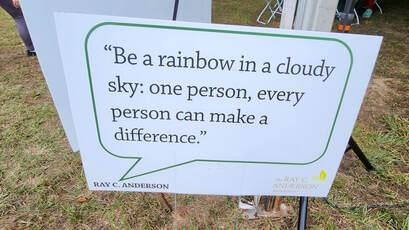
By Maurice Carter, Sustainable Newton Cofounder & Past President "Brighten the corner where you are." It's a line Ray Anderson internalized from Sunday school as a boy, and he used it often to lift up those around him and inspire them to make a difference. Even though cancer took Ray from his family and his life's work in 2011, that same spirit was ever-present for those of us who assembled Sunday for the Ray C. Anderson Foundation's RayDay celebration at Serenbe.
By the Sustainable Newton Board  On Tuesday, November 7, voters in the cities of Covington and Porterdale will elect new mayors and fill multiple city council seats. Advanced in person absentee voting starts Monday, October 16. To help you make informed choices, we asked candidates in each contested race to respond to five questions about sustainability.
We're sharing the answers we received below and noting which candidates did not respond. We encourage you to consider this information before casting your ballot.  By Sara Vinson, Sustainable Newton Co-Founder My husband and I contracted with Energy Consulting Services to perform an energy audit of our home earlier this summer, and the findings were totally unexpected. We thought we knew our house and its weak spots in terms of energy efficiency/loss. However, the audit revealed problems we were unaware of and could not have discovered on our own. The information from the energy audit will guide improvements we plan to make over the coming months.
We were inspired to pursue the audit by my involvement with Sustainable Newton's Inflation Reduction Act (IRA) Committee, which is working to make the home energy financial incentives of the IRA more understandable and accessible for Newton County residents. By Maurice Carter, Sustainable Newton Co-Founder & Past President 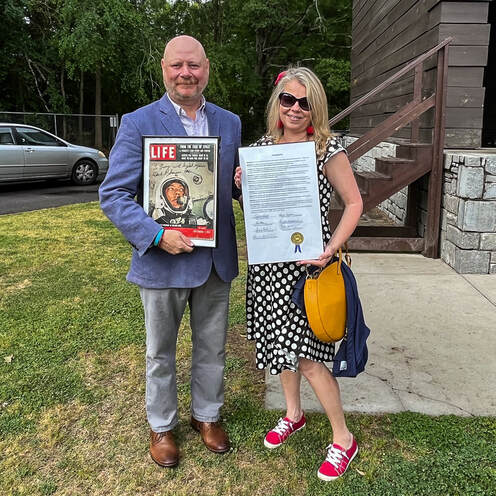 Covington Assistant City Manager John King with a Sep 2, 1957 Life Magazine cover featuring his great uncle David Simons. Covington Assistant City Manager John King with a Sep 2, 1957 Life Magazine cover featuring his great uncle David Simons. Vision, planning, and hard work make good things happen. But don't underestimate the power of serendipity.
In an earlier blog post, I told of an old letter my wife found tucked inside a book in her office. Written to her while she was Mayor of the City of Covington, the letter prompted me to reflect on my own memories of its writer, Dr. David G. Simons, and a presentation he gave to the Covington mayor and council back in 2008. The subject of the letter and that presentation was Climate Change. In a subsequent conversation with current Assistant City Manager John King, he told me Dr. Simons was his great uncle. John also told me his father had an autographed original of the 1957 Life Magazine cover featuring Dr. Simons, which his father was lending to the Covington Welcome Center. By Maurice Carter, Sustainable Newton Co-Founder & Past President  At Christmas, I wrote a post titled Climate Is a Dickens of a Problem, in which I referenced the ghosts of climate past, present, and future. This week, I encountered one of those kind and gentle spirits of our past in my own home.
My wife Kim and I were cleaning out our offices to prepare for home remodeling, when we found a letter tucked inside a hardcover volume on her bookshelf. It was from David G. Simons, MD, an elderly Covington resident who -- as it turns out -- was quite famous. His photo once graced the cover of Life magazine. Writing on November 13, 2008, Dr. Simons was following up on a presentation he gave to the City of Covington Mayor and Council. (Kim was Mayor then.) His urgent message warned local officials about the threat of climate change. Reading the letter now, almost 15 years later, Bob Dylan's line from Tangled Up in Blue says it best: "Every one of them words rang true and glowed like burning coal, pouring off every page like it was written in my soul from me to you.” By Maurice Carter, Sustainable Newton Marketing & Communications Director  In his Ecocentrity Blog, Ray C. Anderson Foundation Executive Director John Lanier recently shared video of a speech by his grandfather, Ray Anderson, to illuminate a piece about our planet's crisis of biodiversity loss. Like most recordings of Ray Anderson, this 2006 speech relating his 1997 "spear in the chest" moment after reading Paul Hawken's "The Ecology of Commerce" is profound. Everyone should watch the the entire seven minutes at the bottom of this page, but I found these words especially worthy of transcribing here. Ray said: "I had agreed reluctantly -- and I underline 'reluctantly' -- to speak to a newly assembled environmental task force of Interface people from around the world. I had been asked to offer an environmental vision. And I did not have an environmental vision. I did not want to answer this awkward question -- awkward for me because I could not get beyond: 'We obey the law, comply.' And I knew somehow that comply was not a vision." I'm struck by many things when I hear Ray Anderson speak.
By Maurice Carter, Sustainable Newton Marketing & Communications Director "Are these the shadows of the things that will be, or are they shadows of the things that may be only? Men's courses will foreshadow certain ends, to which, if persevered in, they must lead. But if the courses be departed from, the ends will change. Say it is thus with what you show me!" -- Ebeneezer Scrooge to the Ghost of Christmas Future from "A Christmas Carol" by Charles Dickens  In A Christmas Carol, Jacob Marley's ghost pays a Christmas Eve visit to his former partner Ebeneezer Scrooge to warn him of the torment awaiting in the afterlife. Marley speaks of his own suffering penance for his deeds in life and implores Scrooge to change while there is still time. Scrooge's reaction, of course, is to deny the reality of what he sees and hears with his own eyes and ears. He is spooked, but persistent in his denial of the apparition before him. Thankfully, for Scrooge, Marley's ghost is not yet done with him. And a magical journey in one night ultimately changes the life of Ebeneezer Scrooge and transforms the world around him.
How did that happen? And what is the lesson for those of us seeking to persuade family and friends to join us in striving to avert a different unpleasant fate. One manifesting itself as our climate crisis. By Emily Griffith, Sustainable Newton Secretary  If you’re reading this, odds are climate and environmental responsibility are important to you. And with public opinion polls showing 75% of Americans are alarmed, concerned, or cautious about climate change, you likely have family and friends on your shopping list who would appreciate a thoughtful gift given with sustainability in mind.
But shopping, wrapping, and getting gifts to loved ones on time is stressful enough! Won’t fretting over environmental impact make that even harder? It’s actually easier than you may think, and Sustainable Newton is here to break down the terms and offer up some environmentally sound gift ideas for the holidays. Let’s start by identifying some items that contribute to waste and often go ignored.
By Maurice Carter, Sustainable Newton Marketing & Communications Director
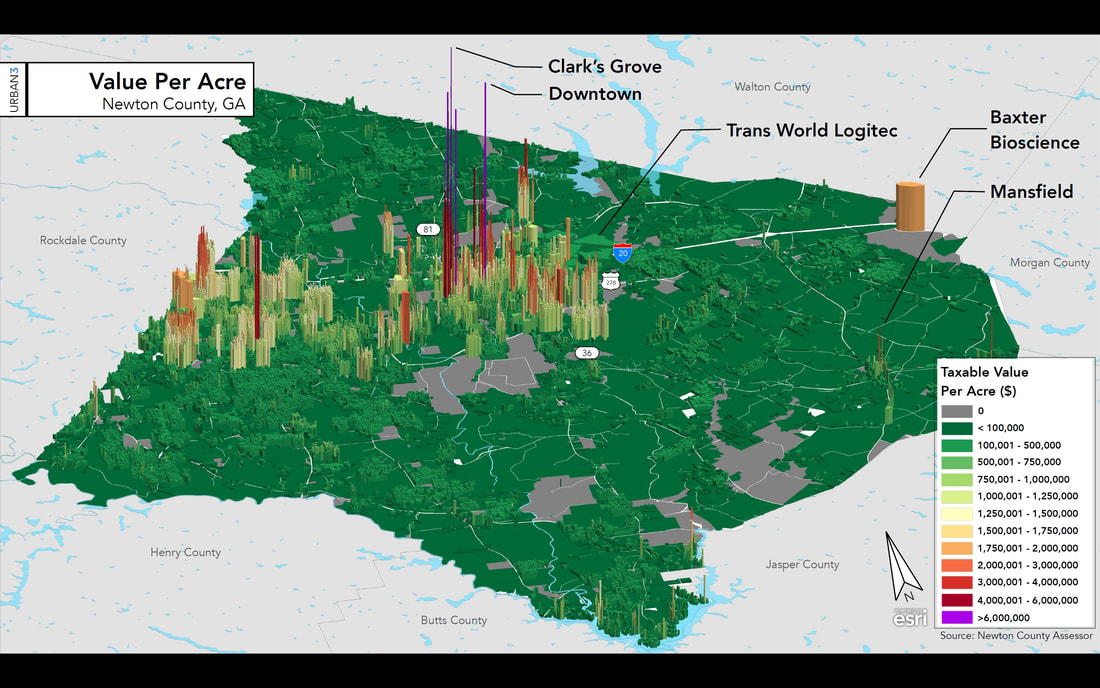 Urban3 mapped where taxable value is created in Newton County Urban3 mapped where taxable value is created in Newton County
The financial model the City of Covington is operating under creates a $8.4M/year shortfall against the long-term maintenance and replacement costs for the city's infrastructure (roads, water and sewer lines, and electric and natural gas lines). And that deficit will grow by that much every year it goes unfunded. Put into practical terms, the city can ultimately only afford 46% of its existing 104 miles of roads inside the city limits. That was the message delivered to elected officials, city staff, and citizens last week by Joe Minicozzi, principle of the consulting firm Urban3.
By Emily Griffith, Sustainable Newton Member On Sunday, October 16, Sustainable Newton was one of ~50 organizations invited by the Ray C. Anderson Foundation to participate as Eco-Exhibitors for their RayDay Celebration at Serenbe in south Fulton County. It was an honor and privilege to be included in this annual celebration of the foundation's namesake. Sustainable Newton member Emily Griffith attended with her family and shares this first-hand account of a very amazing day. 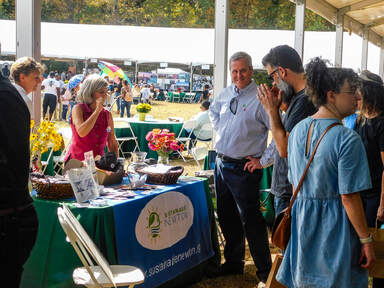 When my family and I embarked on our journey to Serenbe, we didn’t quite know what the day had in store. As we drove through the breathtaking countryside, I began to take note of my surroundings, making sure to soak up the atmosphere. The bustling noises of the city soon transformed into birds chirping and insects trilling. Sun-dappled roads lined with forest escorted us to our destination among the pines. As we inched closer to our destination, the serene and silent parade of electric vehicles signaled that our first-ever RayDay was just around the corner.
By Maurice Carter, Sustainable Newton Marketing & Communications Director  We've gone from no one paying attention to the electric vehicle battery supply chain to everyone freaking out about it.
Not long ago, nickel was a coin, cobalt was a paint color, and lithium was a drug used to treat certain mood disorders. You might have heard of lithium-ion batteries, but they weren't something sold from a rack in the checkout line at your drug store. Even if there was one inside your cellphone, you couldn't get inside to touch it. Electric vehicles (EVs) changed that. Or, rather, America's late-to-the-party-gotta-catch-up embrace of EVs coupled with global supply chain issues have made batteries fodder for headlines like these:
Locally, public reaction for and against Rivian's planned assembly plant near Rutledge, Georgia has placed an even sharper edge on concerns raised by global events like the war in Ukraine. By Dr. Marcus Pollard, Agricultural Educator & Young Farmer Advisor with Newton College & Career Academy 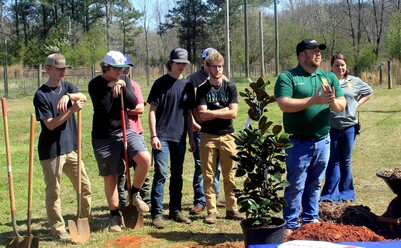 Dr. Marcus Pollard with students from the Newton College & Career Academy & Eastside High School Eco Eagles (Photo Credit: Dr. Lois N. Upham) Dr. Marcus Pollard with students from the Newton College & Career Academy & Eastside High School Eco Eagles (Photo Credit: Dr. Lois N. Upham) Speaking from the lens of one of the agricultural education teachers at Newton College & Career Academy, we are consistently looking to connect things. We strive to connect our students with curriculum, our curriculum with industry, and our industries with students. Ultimately that’s what sustainability is, right? Connecting things with one another? Webster defines sustainable as : capable of being sustained. Well, what does Webster say about sustained? “Maintained at length without interruption or weakening."
That’s what I’m talking about. I don’t want our student’s progress to be interrupted, and I certainly don’t want it to be weakened. I want the experiences our students have to strengthen them as individuals, therefore strengthening our curriculum and local industries. Much like any type of braided wire or rope, we believe the more experiences we can connect with a student, the stronger that student becomes. Our students hopefully become more sustainable when they come through our program. By Maurice Carter, Sustainable Newton President  It's 10 o'clock (AM), and I have a feeling all's not well.
For a second straight late-December day, I'm sweating in shorts and a t-shirt, as thunder rumbles and heavy rain pounds my office windows. Thankfully, the tornado watch expired at 5 AM, but it's still not a fit day out for man nor beast. When I did venture forth between deluges, I was barefoot. And, despite the drizzle, I still can't help stopping to marvel at a summer daisy blooming by our driveway... at the bearded irises flashing purple April buds in December... at the koi in our pond who -- instead of resting dormant in cold, deep waters as they should be this time of year -- are swimming at the surface mouthing "Feed me. FEED me. FEED ME!" Around the yard, thrift, black-eyed susan, and baby's breath are pushing out fresh blooms, and the annual herbs in our pots and beds remain abundant and green. |
Categories
All
Archives
February 2024
|
 RSS Feed
© COPYRIGHT 2019-2022. ALL RIGHTS RESERVED.